
The Portfolio That Knew the Future and Still Lost 76%

What a portfolio with perfect foresight teaches us about the emotional reality of investing.
People often assume that risk and volatility are the same thing. In investing, “risk” is commonly measured as the dispersion of returns around an average. What statisticians call standard deviation. Put simply, it measures how much an investment price moves up and down over time.
But perhaps it is worth challenging this assumption.
Imagine for a moment that you could do the impossible. You knew with absolute certainty which stocks in the S&P 500 would be the biggest winners over the next five years. Every five years, you simply reshuffled your portfolio and kept only those future winners. Perfect foresight. No mistakes. No uncertainty.
That is essentially what Wesley Allan Gray explored in his study, Even God Would Get Fired as an Active Manager. The exercise intentionally used an unrealistic advantage: complete knowledge of the future. Returns were analysed from 1927 through 2016 using a portfolio built with perfect foresight.
As expected, the results were extraordinary. This “perfect knowledge” portfolio generated annual returns of about 29%. On the surface, it looked like investing perfection.
But then something surprising happened.
Despite knowing the future, the portfolio still experienced enormous volatility. In fact, it was more volatile than the market itself. Even more striking, during the crash between 1929 and 1932, this supposedly perfect portfolio lost around 76% of its value.
Pause and think about that for a moment.
Even a portfolio built with perfect foresight could not escape severe losses and painful drawdowns. The pain did not end there; here is a chart of the drawdowns on the portfolio over time:
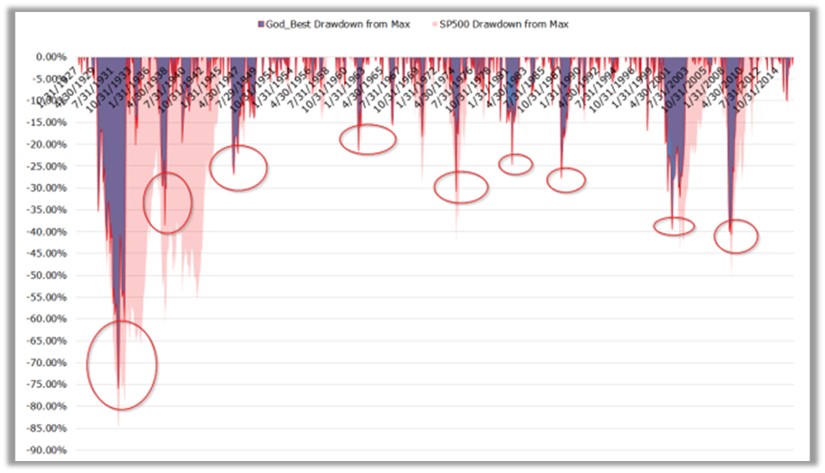
Over time, the “God Portfolio” suffered nine additional drawdowns ranging from 20% to 41%. The bottom-line result is that perfect foresight has great returns, but gut-wrenching drawdowns. Clearly, even a “perfect” long portfolio can bring a long-only investor a lot of pain.
The conclusion is profound: perfect foresight produced extraordinary returns, but it still came with gut-wrenching periods of decline. Even a “perfect” portfolio demanded an enormous emotional price from the investor.
This highlights something important: investing is not about avoiding discomfort. Not even perfect knowledge can eliminate uncertainty, volatility, or periods of deep decline.
Success does not come from predicting the future perfectly. It comes from having the patience, emotional resilience, and understanding to remain invested through difficult periods.
Even if you could know the winners in advance, you would still need the ability to survive the journey.
Volatility is not risk. Volatility is a test.
It tests your time horizon. It tests your understanding. It tests your ability to endure temporary pain in service of a long-term goal.
Volatility is a permanent feature of markets. We do not avoid it; we live through it and eventually, it passes.
Volatility ≠ Risk
Volatility = Discomfort
Discomfort is often the price you pay to increase the probability of reaching your goals.
As Dolly Parton once said: “The way I see it, if you want the rainbow, you gotta put up with the rain.”
Written by Marius Kilian
Source
* “Even God Would Get Fired as an Active Investor”, Wesley Gray, alphaarchitect.com, August 2021
* “Risk & Reward”, Ben Carlson, Harriman House