
Become a Better Consumer of Financial Advice

The advice you value today will shape the life you experience tomorrow.
You seek financial advice for an important reason. You want to make better decisions, protect the people who matter to you and use your money to create a better life. You want greater freedom, more security and confidence that your financial choices are taking you somewhere meaningful.
Achieving this requires more than finding a qualified advisor or selecting a good investment portfolio. It also requires becoming a discerning consumer of advice.
The quality of advice you receive is shaped partly by what you expect, what you ask for and what you choose to reward. When you learn to recognise the difference between advice that feels reassuring and advice that genuinely serves your interests, you improve more than the conversation. You improve the decisions that will shape the rest of your financial life.
We all want to feel more certain
Investing asks us to commit money today without knowing precisely what tomorrow will bring.
That uncertainty is uncomfortable for all of us. It is natural to want an advisor who can make the future feel clearer and more controllable. We want to know which investment will perform best, when markets will rise and whether our capital will be safe. There is nothing wrong with wanting these things. The difficulty is that some of them cannot be promised honestly.
An advisor can help you make better decisions, but no advisor can make the future certain. Someone who speaks confidently about what will happen next may leave you feeling reassured. But confidence is not evidence of competence, and reassurance is not the same as good advice. The future does not become more predictable because someone describes it with greater conviction.
The most attractive answer may not be the most valuable one
Imagine that you are concerned about markets and believe you should move your investments to cash. One advisor agrees immediately. The recommendation feels sensible and provides relief. Another advisor slows the conversation down. They ask what has changed in your long-term objectives, explain the consequences of leaving the market and remind you that the decision to move to cash will eventually require another decision about when to return.
Which advisor has provided more value? The first may have given you the answer you wanted. The second has helped you examine whether the decision serves the future you want. That distinction is important. Sometimes we seek advice because we want help reaching a decision. At other times, without realising it, we seek someone who will approve a decision we have already made. If one advisor challenges us, we can continue searching until someone agrees. We end up mistaking validation for advice.
It is a normal human response to uncertainty. We naturally prefer information that supports what we already believe and reduces our discomfort. The opportunity lies in becoming aware of when this is happening.
The advice you reward is the advice the industry will provide
Every industry responds to what its clients value. Financial advice is no exception. If investors reward confident forecasts, exciting promises and recommendations that validate their existing preferences, more of that advice will be supplied. If investors value honesty, humility, realistic expectations and disciplined preparation, the advice profession will have stronger reasons to provide those qualities.
This gives you more influence than you may realise. You are not responsible for the shortcomings of the financial industry. Advisors remain responsible for acting professionally, providing suitable advice and placing their clients’ interests first but as a client, you help establish what is valued within the relationship.
An advisor who tells you that your expectations are unrealistic is taking a risk. So is an advisor who discourages you from chasing a recently successful investment or refuses to make a confident prediction about markets. They know that another advisor may be willing to offer the certainty you want.
When honest advice is punished and reassuring advice is rewarded, advisors learn which conversations preserve the relationship. The danger is that the relationship gradually becomes organised around comfort rather than better decisions. You can and should help change that.
Give your advisor permission to be honest
One of the most valuable things you can say to an advisor is: “I do not expect you to predict the future. I expect you to help me make good decisions within an uncertain future.”
That simple commitment changes the conversation. It gives your advisor permission to discuss trade-offs instead of presenting ideal outcomes. It allows uncertainty to be acknowledged without being mistaken for incompetence. It creates room for the advisor to challenge you when fear, excitement or recent performance begins influencing your judgement.
Honesty in an advisory relationship must work both ways. You should expect your advisor to be candid about risk, uncertainty, costs and the limitations of every strategy. In return, the advisor needs you to be open about your fears, expectations, prior experiences and what you may already be motivated to do.
That reciprocity creates a stronger relationship. Both parties become committed to the same outcome: not making every conversation comfortable but making each decision more considered.
What is valuable advice?
Valuable advice may not always be the most exciting advice. A good advisor may tell you:
- your desired return requires accepting more uncertainty;
- a diversified portfolio will sometimes appear disappointing;
- a sound investment manager can underperform for meaningful periods;
- the latest winner may not remain the winner;
- changing strategy may relieve today’s anxiety while weakening tomorrow’s outcome;
- every investment choice involves a trade-off;
- and there are things about the future that nobody can reliably know.
These statements do not reveal a lack of expertise. They demonstrate an understanding of where genuine expertise ends. The advisor’s confidence should be grounded in a disciplined process, not in an assumed ability to foresee everything that might happen.
True competence is not the ability to predict one future with certainty. It is the ability to prepare you for a range of possible futures.
Become a better consumer of advice
If we want a better advice industry, we must become more discerning consumers of advice.
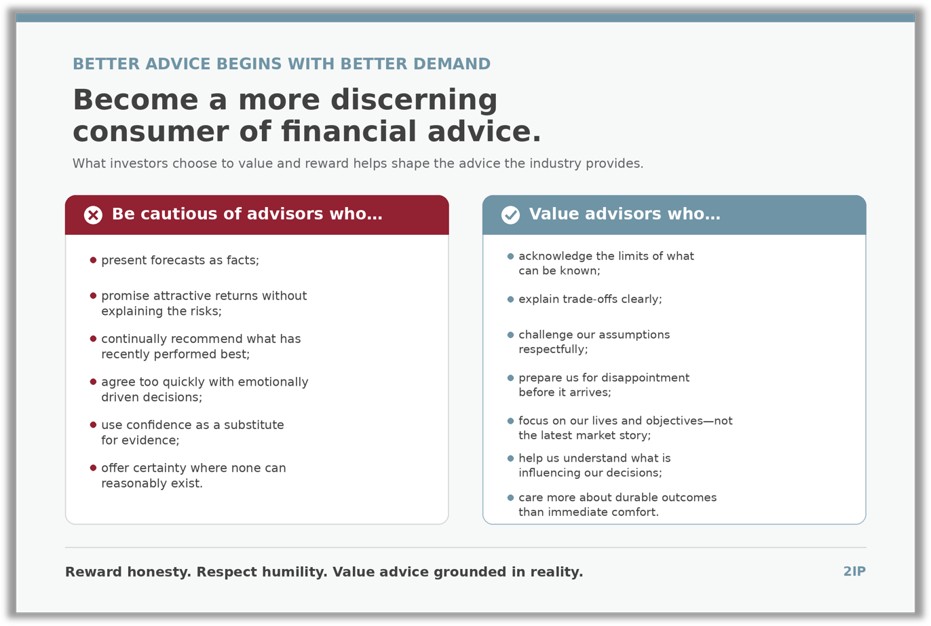
Most importantly, notice how you respond when an advisor tells you something you would prefer not to hear: Do you become curious or defensive? Do you examine the reasoning or begin looking for someone who agrees with you? Do you interpret humility as weakness or recognise it as honesty?
The answers can tell you something important about the kind of advice you may be encouraging.
Ask better questions
A better advisory relationship begins with exploring better questions. Instead of asking only, “Which investment will perform best?”, consider asking:
- What would need to go right for this recommendation to succeed?
- What could cause it to disappoint?
- What range of outcomes should I realistically expect?
- What trade-offs am I accepting?
- How might I feel when this strategy temporarily underperforms?
- What would justify changing the plan?
- What would not justify changing it?
- How does this decision support the life I am trying to build?
These questions shift the relationship and signal to your advisor that you value honesty and thoughtful judgement more than confident storytelling, and long-term resilience more than short-term reassurance.
Awareness is the starting point
You cannot remove emotion from financial decisions, and you do not need to. Fear, hope and excitement contain useful information. The problem begins when they influence your decisions without your awareness.
Awareness creates a pause between what you feel and what you do. Within that pause, you can ask: “Do I find this advice persuasive because the reasoning is sound or because the answer is emotionally convenient?” That question restores your agency.
It allows you to recognise when you are seeking clarity and when you are merely seeking comfort. It helps you distinguish between an advisor who supports your goals and one who simply supports your current opinion. This may be the most valuable discipline in investing: not predicting what happens next but becoming more aware of what is influencing the decisions you make now.
Better advice serves a better life
The purpose of financial advice is not merely to produce an investment return. It is to help you use your resources in ways that support a meaningful life. It should help you make considered trade-offs, protect important choices and remain committed to what matters when circumstances become difficult.
Advice that feels good today but creates unrealistic expectations does not serve that purpose. Neither does a relationship built around predictions, performance chasing and the avoidance of difficult conversations. Honest advice may occasionally make you uncomfortable. But temporary discomfort can protect you from decisions with lasting consequences.
The advisor who challenges you respectfully may be contributing more to your future than the advisor who always agrees. The advisor who admits uncertainty may be more trustworthy than the one who promises to remove it. The advisor who prepares you for disappointment may be giving you the resilience to remain committed when disappointment eventually arrives.
You hold the key to better advice
A better advice profession will not be created by advisors alone. It will also be shaped by investors who know what valuable advice looks like and are prepared to reward it.
You can choose to support advisors who tell the truth, explain reality and help you think more clearly even when another person is willing to offer a more comforting answer. You can make it safe for your advisor to disagree with you.
When investors begin expecting and rewarding these qualities, the supply of advice will follow.
Investors hold the key to that future. Better advice begins with what investors choose to value.
Written by Marius Kilian