
Ten Investment Truths Every Long-Term Investor Should Understand

Ten Investment Truths Every Long-Term Investor Should Understand
Investing in equities has historically been one of the most effective ways to build wealth over time but the journey is neither smooth nor predictable.
The long-term rewards of equity investing come with a price: uncertainty, volatility and extended periods during which patience is tested. Investors who understand this before they begin are better equipped to remain disciplined when markets inevitably become uncomfortable.
Here are ten enduring truths that every long-term investor should understand.
- Markets Rise Over Time but Never in a Straight Line
Equity markets have delivered positive returns in most years. Yet even during positive years, investors frequently experience meaningful declines along the way.
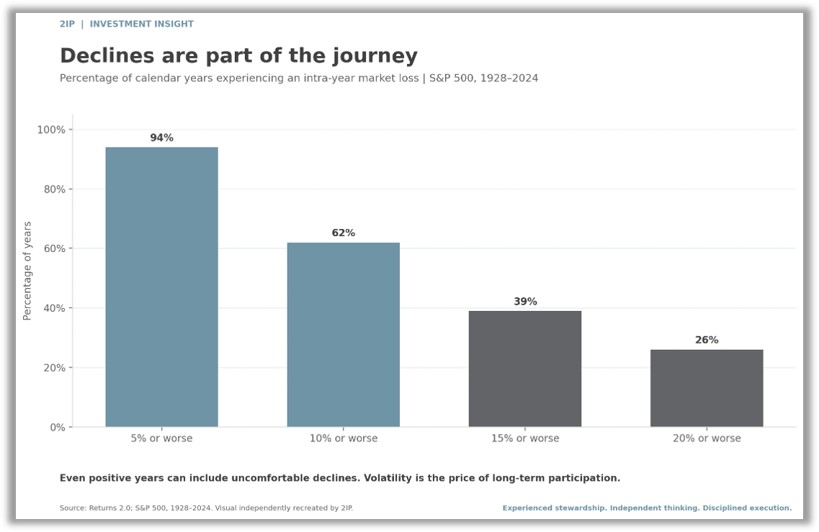
A market can fall sharply and still finish the year higher. Temporary losses are therefore not unusual interruptions to equity investing; they are part of the experience.
The important question is not whether markets will decline. They will. The better question is whether your portfolio, financial plan and behaviour are prepared for it.
- Returns Arrive Unevenly
Investors often think of long-term returns as though they arrive in an orderly sequence. If equities have historically returned a particular average, it is tempting to imagine earning something close to that amount every year.
Markets do not work that way.
Returns arrive in bursts. Strong years, weak years and occasionally severe losses combine to produce the long-term average. The average may be useful for planning, but it rarely resembles the investor’s actual year-to-year experience.
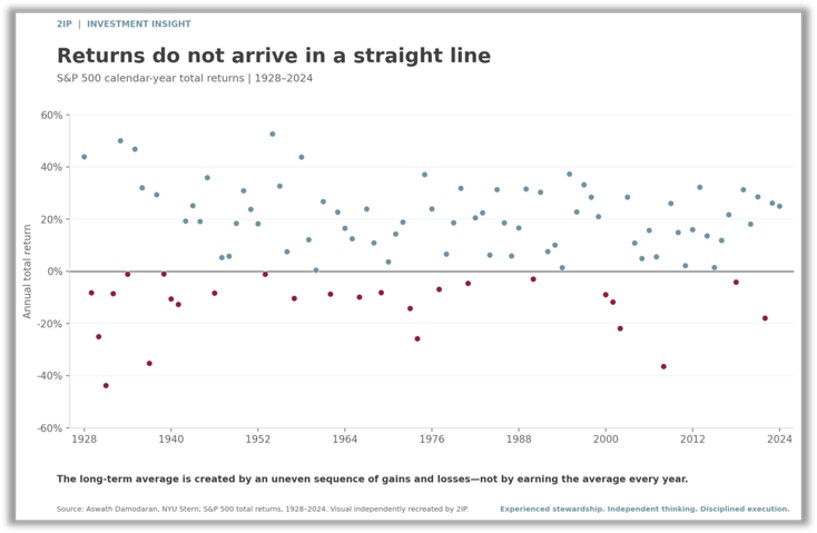 Compounding does not require consistent market returns. It requires consistent investor behaviour.
- Losses Can Happen Quickly
Markets usually rise gradually, but they can fall with remarkable speed.
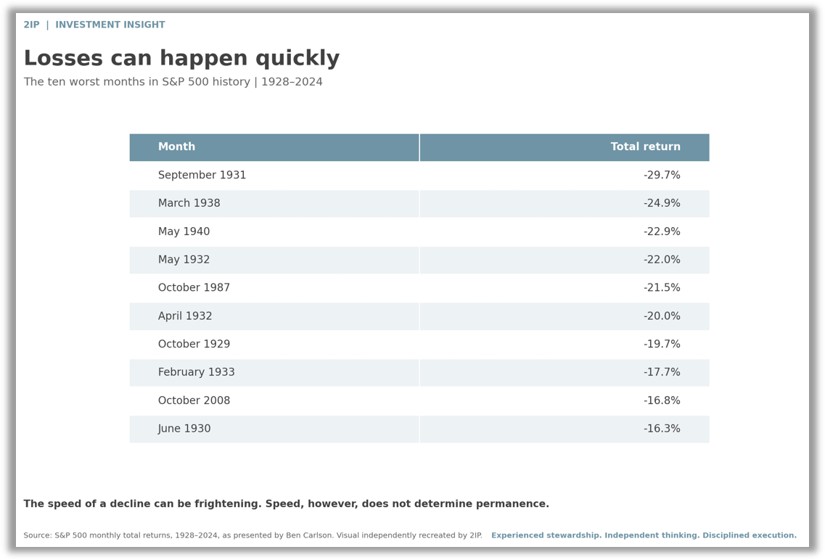
Confidence can take years to build and only days to disappear. This asymmetry is one reason market declines feel so unsettling: investors have little time to adjust emotionally before the losses become significant.
The speed of a decline does not necessarily tell us anything about its permanence. But it can provoke decisions that turn temporary volatility into permanent financial damage.
The real risk is often not the fall itself. It is how we respond to it.
- Difficult Markets Often Improve Future Prospects
After prices have fallen, investors naturally feel less confident. Yet lower prices may improve the prospective returns available to patient investors.
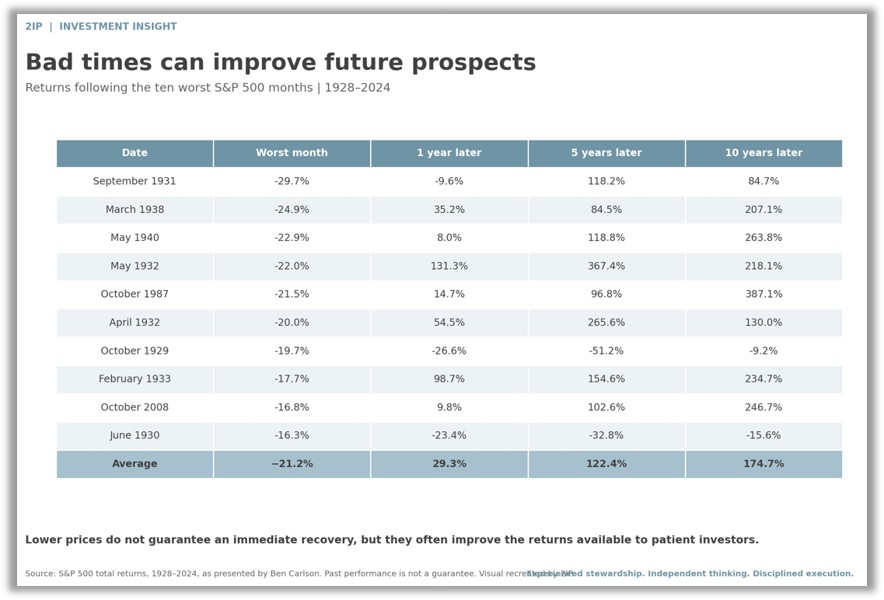 The opposite is also true. After an extended period of strong performance, confidence is usually high, but valuations may be less attractive and future returns more constrained.
This creates one of investing’s enduring paradoxes: assets often feel safest after they have become expensive and most dangerous after prices have fallen.
Opportunity rarely arrives accompanied by comfort.
- Market Trends Can Persist Longer Than Expected
Investment cycles do not operate according to a reliable timetable. Markets, sectors and investment styles can remain in favour or out of favour for much longer than investors expect.
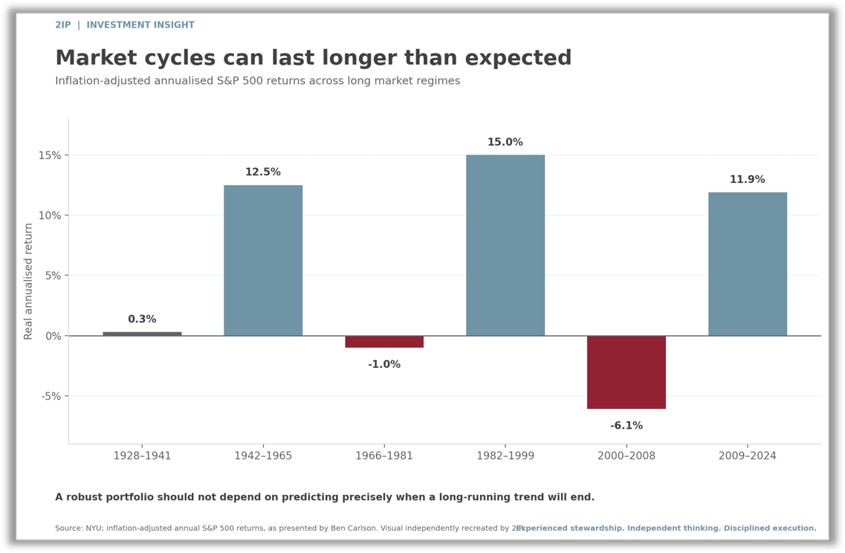 Strong performance can continue long after something appears expensive. Underperformance can persist long after something appears attractive. This is why market timing is so difficult. Being fundamentally right is not enough; you must also know when the market will agree with you.
A robust portfolio should not depend on predicting precisely when a trend will begin or end. It should be designed to remain resilient across a range of possible outcomes.
- The Average Return Is Rarely the Actual Experience
Long-term equity returns are often summarised as a single annual percentage. This is useful shorthand, but it can create false expectations.
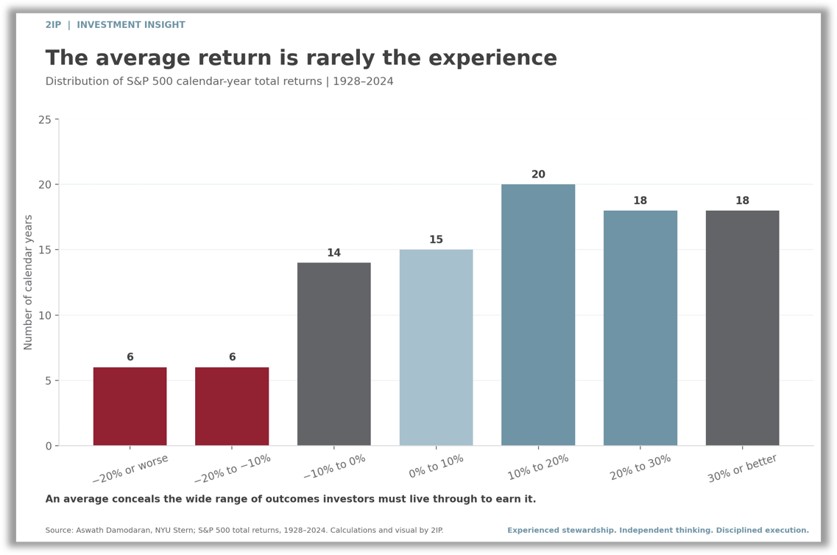 An average is the mathematical result of many very different outcomes. It hides the volatility, uncertainty and emotional discomfort experienced along the way.
Investors do not live their investments in a spreadsheet. They live them through periods of optimism, fear, regret and doubt. The return shown in a long-term table is only available to the investor who can endure the path required to earn it.
- Every Investment Principle Has Exceptions
No asset class, investment style, manager or strategy outperforms in every environment.
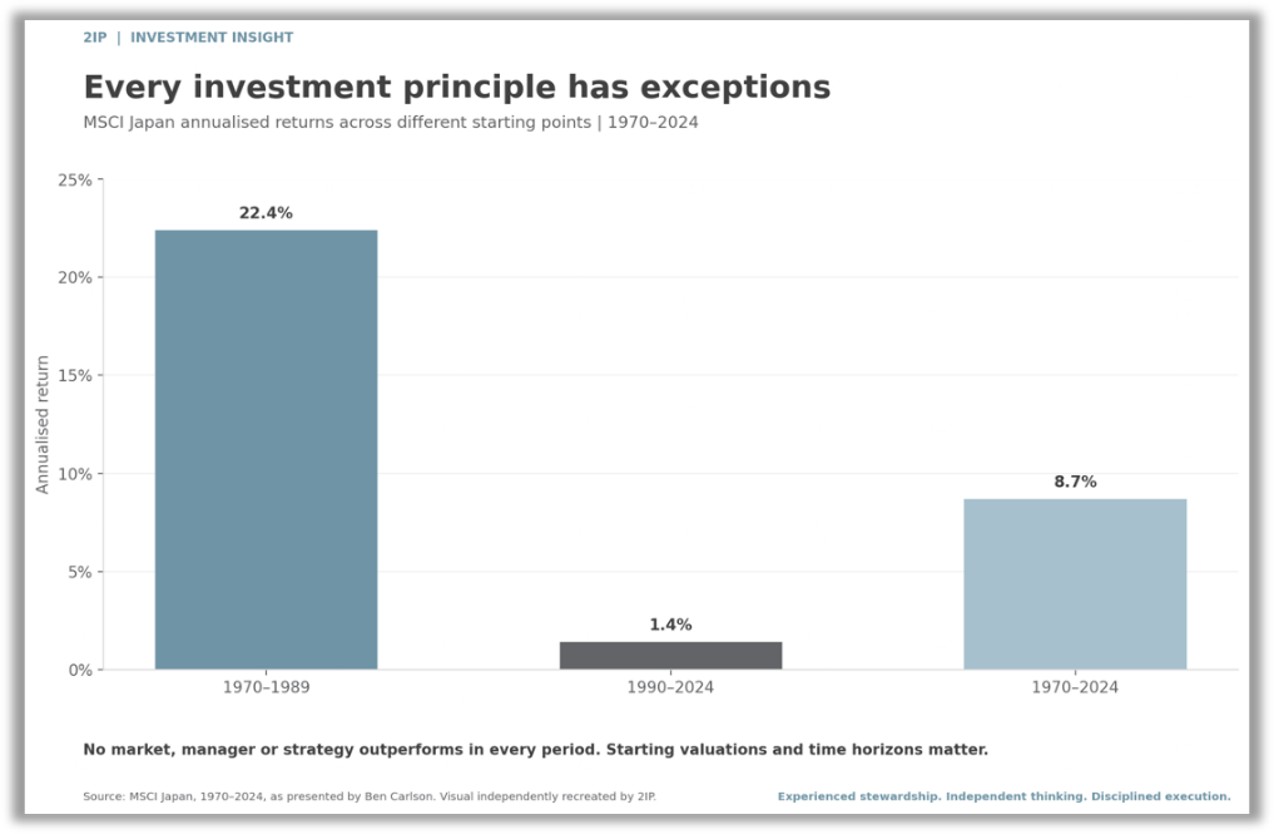
There will always be examples that challenge a widely accepted investment principle. Diversification can lag concentration. Quality can trail speculation. Active management can underperform an index. Even sensible decisions can produce disappointing short-term outcomes.
This does not automatically invalidate the principle or process.
A sound investment strategy should be judged by whether it remains reasonable across many possible futures not whether it wins under every set of circumstances. If something worked all the time, it would contain no uncertainty. Without uncertainty, there would be little reason to expect a meaningful return.
- History Is Valuable but Limited
Historical market data provides perspective. It helps us understand how markets have behaved through recessions, wars, inflation, financial crises and technological change.
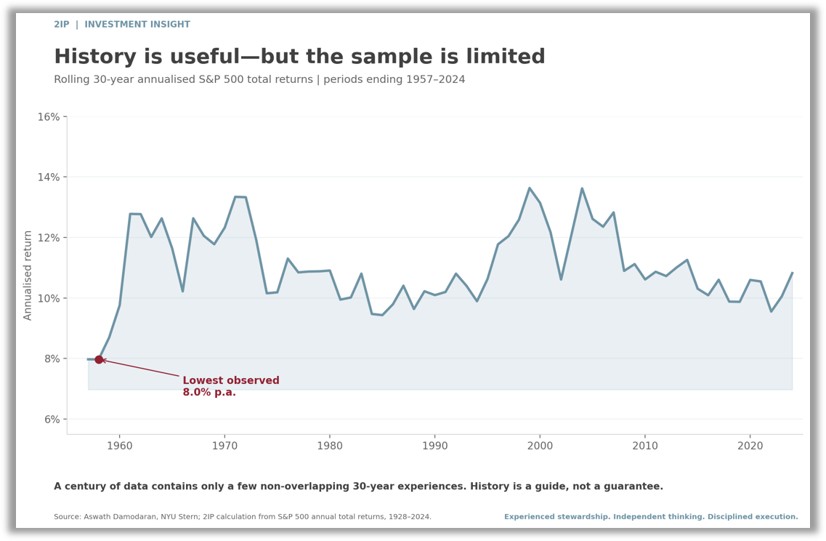 But even a century of market history contains relatively few independent long-term investment periods. The sample is smaller than it appears because many of the periods overlap. History is therefore a guide, not a guarantee. We should use it to understand the range of possible outcomes, not to convince ourselves that the future must unfold in precisely the same way as the past.
- Equities Do Not Always Win
Equities have historically rewarded long-term investors, but they do not outperform every asset class over every period. Bonds, cash, property and other assets can lead for years at a time. Even a decade may not be long enough for equities to demonstrate their expected advantage.
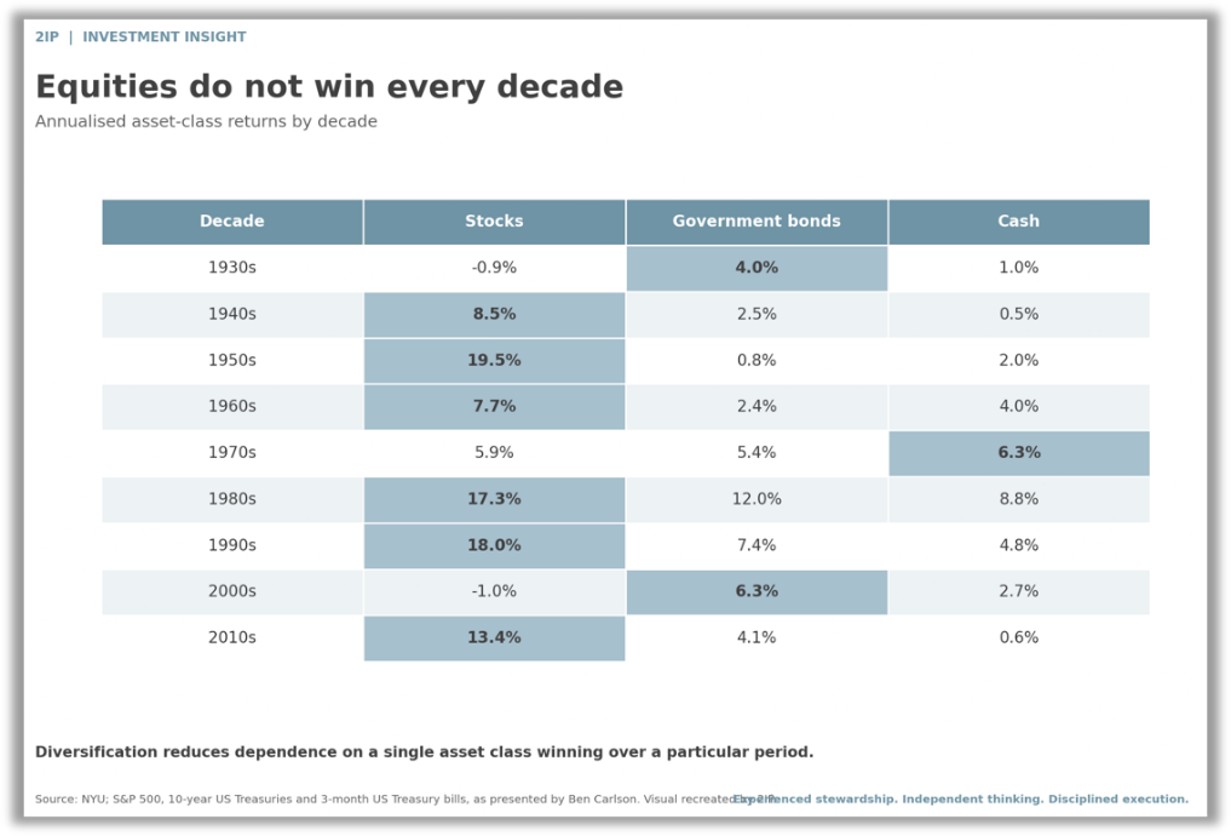 This is why diversification matters.
Diversification does not guarantee that every part of a portfolio will perform well simultaneously. In fact, if everything is performing well at the same time, the portfolio may not be meaningfully diversified.
Its purpose is to reduce dependence on any single outcome and make the overall investment journey more durable.
- Long-Term Optimism Is an Investment Advantage
Markets reward the investor who believes that businesses will continue to innovate, adapt and create value over time.
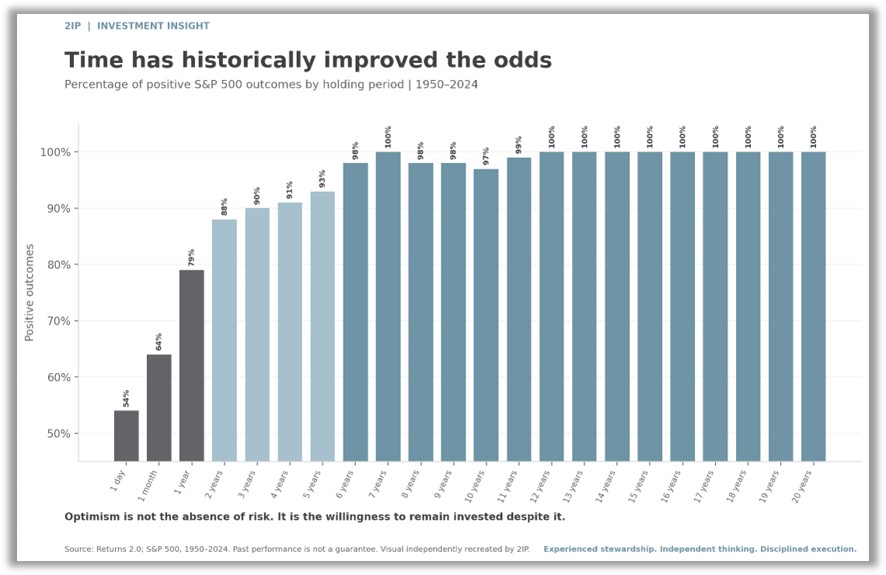 This does not require ignoring risks or pretending that setbacks will not occur. Optimism is not the belief that nothing will go wrong. It is the belief that progress can continue despite the things that go wrong.
The longer the investment horizon, the greater the historical likelihood that temporary declines are absorbed into a positive long-term outcome.
Pessimism may sound intelligent because it focuses attention on everything that could fail. But wealth has generally been built by people willing to invest in the possibility that the future can improve.
The Takeaway
Successful investing does not require certainty about what markets will do next.
It requires a clear purpose, a suitably constructed portfolio and the discipline to remain committed through an uneven and unpredictable journey.
The greatest advantage is seldom superior forecasting. It is the ability to continue behaving sensibly when markets make sensible behaviour difficult.
Markets will rise and fall. Leadership will change. Returns will arrive unevenly. There will always be reasons to feel uncertain.
The objective is not to eliminate that uncertainty. It is to build an investment approach and an investor that can endure it.
Adapted and written by Marius Kilian
Source
This summary was inspired by Ben Carlson’s “10 Things You Need to Know About Investing in Stocks”, published by A Wealth of Common Sense. The principles have been independently interpreted and presented through 2IP’s investment philosophy. Read the original article.