
The Dark Side of Compounding

The capital base from which returns compound is critically important. Compounding can only build on what remains.
When capital suffers a deep drawdown, the process does not simply pause. It restarts from a much lower base. The mathematics then begins to work against the investor: a 20% loss requires a 25% gain to recover; a 30% loss requires approximately 43%; and a 50% loss requires a 100% gain merely to return to where the journey began.
This asymmetry is the dark side of compounding.
High variability can also create a drag on long-term wealth. Consider two investments that both produce an average annual return of 10% over two years. The first earns 10% in each year. The second gains 50% in the first year and loses 30% in the second. Both have the same simple average return, but they do not produce the same outcome. The steady investment turns R100 into R121. The more variable investment leaves the investor with only R105.
Average returns do not tell the whole story. The sequence and variability of those returns matter because every gain or loss changes the base on which the next return is earned.
This does not mean that all volatility should be avoided. Temporary price fluctuations are an unavoidable part of long-term investing, and trying to eliminate them entirely may produce returns too low to meet an investor’s objectives. The greater danger is exposure to risks that can cause permanent loss, excessive concentration or a drawdown so severe that the investor panics and does not remain invested.
A prudent investment approach must therefore consider not only how capital can grow, but also how the compounding base can be protected. Diversification, valuation discipline, appropriate position sizing and realistic expectations are not signs of timidity. They help preserve the investor’s ability to keep compounding.
The usual threats are familiar. Strong recent performance attracts capital after much of the easy money has already been made. A compelling narrative encourages investors to believe that an exceptional trend will continue indefinitely. Rising prices create confidence, confidence encourages concentration, and concentration magnifies the damage when the story disappoints.
The pursuit of faster compounding can become the very thing that derails it.
The Human Mind Thinks Linearly
We understand straight lines more easily than curves.
If we save R1,000 a month, we instinctively imagine our wealth growing by another R1,000 each month. If an investment earns 10%, we tend to picture a steady and predictable addition to our capital. Our minds naturally extend the recent past forward in a straight line.
Compounding does not move in a straight line. It follows an exponential curve, and exponential curves are deeply unintuitive.
Most investors understand the basic idea of earning returns on both their original capital and the returns accumulated along the way. The real difficulty is living through the part of the journey when the mathematics is working but the results still feel insignificant.
The Part of the Curve Nobody Wants
Consider the familiar example of starting with one cent and doubling it every day. After seven doublings, you have only R1.28. After fifteen, you have R327.68. Yet after twenty-five doublings, you have R335,544.32.
The graph below makes the point visible. The first twenty doublings produce only R10,485.76. The final five add approximately R325,059.
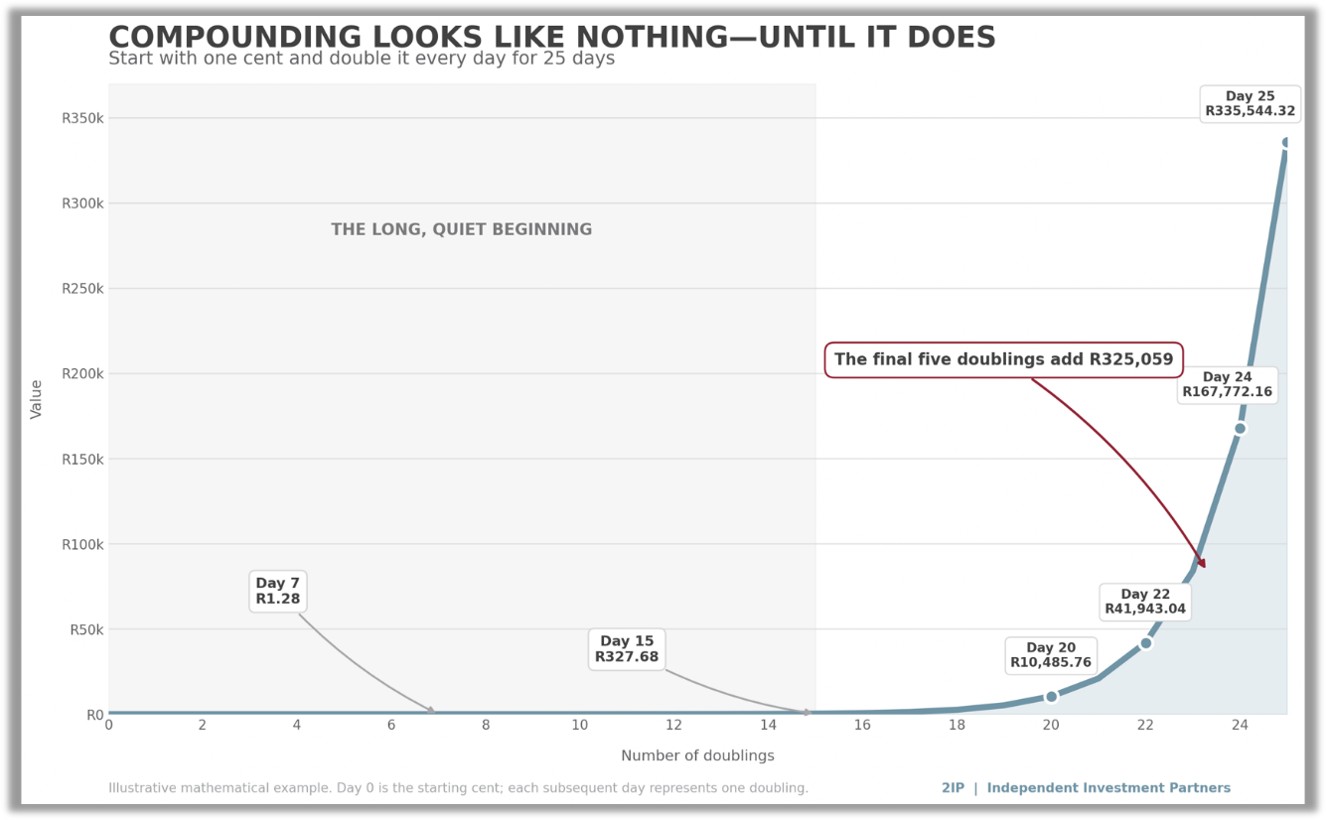
Almost all the visible progress occurs near the end. For much of the journey, the outcome looks trivial. That long, unimpressive beginning is where many people lose patience.
We want the steep part of the curve. But compounding asks us to sit through the flat part first. It asks us to keep saving when the amount still feels small, remain invested when progress seems slow, and resist abandoning a sound strategy for something that appears to be moving faster.
The difficulty is that the early stages of compounding can feel remarkably similar to failure. You are making sacrifices, accepting uncertainty and behaving patiently, yet the reward still appears modest. The effort is immediate; the payoff is delayed.
This mismatch tests the investor long before compounding becomes exciting.
Compounding Is Path-Dependent
Compounding is not only about the rate of return. It is also about the path taken to earn it.
Every period builds on what came before it. Today’s return is earned on yesterday’s accumulated capital. Tomorrow’s opportunity therefore depends partly on whether today’s base has been preserved. Interruptions matter because the later stages of the curve cannot exist without the earlier ones.
This is what path dependency means in practice: the destination depends on successfully remaining on the path.
The most damaging cost is often not the immediate loss. It is the future compounding that the disrupted capital will never have the opportunity to produce.
Everyone wants the dramatic rise at the end of the curve. The more important question is whether we are prepared to accept responsibility for the long, flat and uneventful path that makes it possible.
The curve becomes exciting eventually, but only for those who remain invested long enough to reach that part of it.
Written by Marius Kilian